
Sustainability
Home > Sustainability Statement
Sustainability Statement
OVERVIEW
We are proud to present our tenth annual Sustainability Report which reflects our Group’s sustainability efforts and progress in FY2025. As a globally diversified entity, we continue to encounter both challenges and opportunities across our businesses, and we remain committed to creating long-term value through responsible and resilient practices.
During the year, we strengthened our climate resilience efforts, refined employment practices, enriched community engagements, embraced eco-conscious processes, and continued to pursue digitalisation initiatives. We also marked an important milestone in our sustainability journey by beginning to align our disclosures with the International Financial Reporting Standards (“IFRS”) Sustainability Disclosure Standards issued by the International Sustainability Standards Board (“ISSB”). For the first time, we have incorporated climate-related disclosures aligned with IFRS S2, while progressively enhancing our reporting practices in line with IFRS S1.
In preparing this Report, we have applied certain transition reliefs available under the IFRS Sustainability Disclosure Standards and Bursa Malaysia’s phased implementation provisions under the National Sustainability Reporting Framework (“NSRF“). Specifically, for our first reporting period we have:
• Focused disclosures on climate‑related risks and opportunities in accordance with IFRS S2;
• Not disclosed comparative information for climate‑related risks and opportunities disclosures; and
• Disclosed Scope 3 greenhouse gas emissions only for Category 6: Business Travel and Category 7: Employee Commuting, while progressively building capacity to expand coverage across other categories.
This Sustainability Statement, included in our Annual Report, should be read in conjunction with the detailed disclosures contained in our Sustainability Report 2025, prepared in accordance with Bursa Malaysia’s Main Market Listing Requirements. The Sustainability Report provides comprehensive information on our material sustainability matters, climate‑related risks and opportunities, governance, strategy, risk management, and metrics.
We remain committed to progressively enhancing our sustainability and climate‑related disclosures in line with the NSRF implementation timeline, ensuring that our reporting continues to evolve with global standards and stakeholder expectations. The full Sustainability Report is publicly available online via our website at www.ohb.com.my.
GOVERNANCE STRUCTURE
As part of our commitment to sustainability, we have established a clear governance structure to ensure strategic oversight, compliance, and effective risk management across our business operations.
Sustainability and climate-related data are presented during the quarterly Executive Committee (“EXCO”) meetings, providing a platform for Senior Management to highlight and deliberate on key issues, track progress, and align on strategic actions. Insights and recommendations from the EXCO are then escalated to the Risk Management and Sustainability Committee (“RMSC”), which is responsible for driving sustainability policies, monitoring risks, and ensuring appropriate mitigation measures are in place.
The RMSC reviews and refines sustainability strategies, assesses internal controls, and prepares key findings for the Board of Directors. The Board holds ultimate responsibility for sustainability, endorsing strategies, approving frameworks, and integrating sustainability considerations into the Enterprise Risk Management (“ERM“) framework to guide long-termde cision-making.
This structured approach ensures that sustainability remains a core focus at every level of the organisation, reinforcing OHB’s commitment to continuous improvement, stakeholder value creation, and long-term business resilience.
The illustration below further depicts our current sustainability governance structure. We will continue our efforts to periodically review and refresh our sustainability governance structure to ensure our economic, environmental, social and governance material matters are adequately overseen and managed.
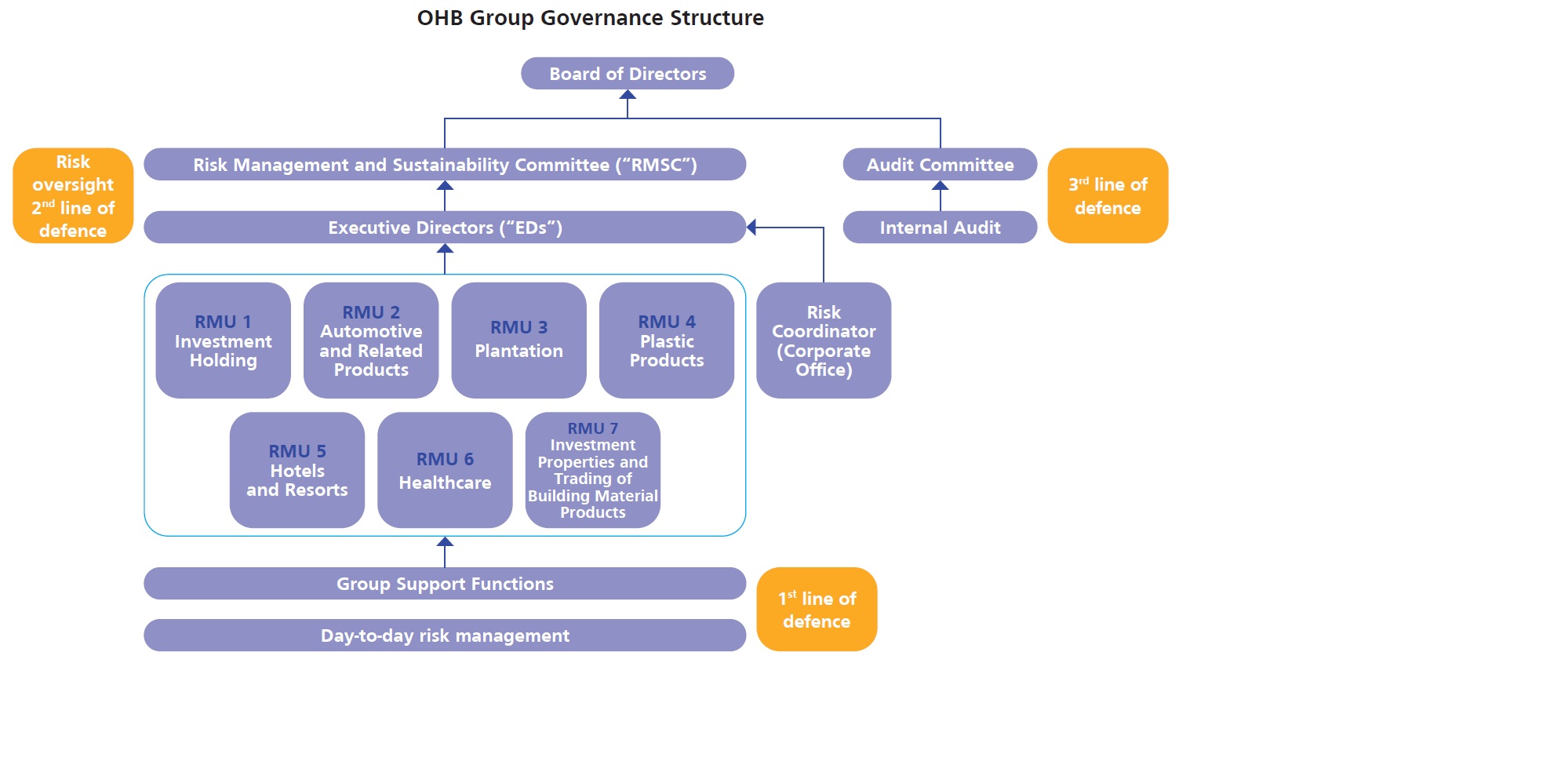
RMU: Risk Management Unit – each unit represents entity within the Group i.e. core business segments in OHB, subsidiaries and significant associates including joint ventures of the Group, where appropriate
SCOPE
Our Sustainability Report covers the sustainability performance and progress from all segments for the financial year ended 31 December 2025, unless otherwise stated.
The Report provides an overview of the Group’s approach to managing its material sustainability matters, with enhanced emphasis on climate-related risks and opportunities relevant to the Group’s operations, strategy and long-term resilience. In line with the Group’s first-time application of IFRS S2, this Report includes expanded climate-related disclosures covering governance, risk management, scenario analysis, transition approach, climate-related risks and opportunities, and financial effects arising from climate-related matters.
SUSTAINABILITY MATTERS
The Group’s material sustainability matters continue to be organised under four key pillars:
1. Economic
Our focus on creating long-term sustainable growth for our stakeholders requires us to constantly review our business practices. This facilitates the delivery of economic performance built on good corporate governance and high ethical standards. We ensure compliance with various national laws in Malaysia, Indonesia, Singapore, Australia, New Zealand, and other markets where we carry out our business activities.
2. Environment
We strive to reduce our environmental footprint by adopting best practices in our daily operations, monitoring our performance against key indicators, and taking appropriate corrective action when necessary to reduce our environmental impact. We work with our stakeholders to enhance awareness of environmental issues, promote sustainable practices, and utilise operational processes that do not adversely affect the environments in which we operate. In FY2025, this pillar was further strengthened through enhanced climate-related disclosures, including the identification and assessment of climate-related risks and opportunities, climate scenario analysis, and initiatives relating to energy management, emissions reduction, renewable energy adoption, water resilience, waste management and operational adaptation.
3. Social
We consider our people to be our greatest asset, and we strive to provide them with adequate support, protection, and growth opportunities at the workplace. We also believe that the Group’s success and growth should bring meaningful impact to the communities in which we conduct our business.
4. Governance
We recognise that effective governance is essential to achieving our sustainability goals. To uphold the highest standards of accountability and integrity, we have adopted a robust corporate governance framework that aligns with industry best practices and regulatory requirements. Our framework is guided by the Part III under Practice Note 9 of Bursa Malaysia’s Main Market Listing Requirements, the Malaysian Code on Corporate Governance (“MCCG“) 2021, Bursa Malaysia’s Corporate Governance Guide (4th Edition) and Bursa Malaysia’s Sustainability Reporting Guide (3rd Edition).
FORWARD-LOOKING STATEMENT
The report outlines the organisation’s commitment to sustainability across Economic, Environmental, Social, and Governance (“EESG“) dimensions, addressing global challenges like climate change, biodiversity loss, and social equity. It emphasises sustainable economic growth through innovation, digital transformation, and resilient supply chains, while integrating climate-related risks into financial decisions. Governance is strengthened by transparency, accountability, and zero-tolerance for bribery, with proactive stakeholder engagement to anticipate risks. The organisation values its diverse workforce, fostering inclusion, training, and well-being to drive innovation. Environmental efforts focus on water and energy efficiency, waste reduction, and climate change management.
Sustainability governance has long been integral into our operations, and during the year we continued to strengthen our reporting structures, governance processes and risk management practices to better align sustainability and climate-related objectives with business priorities. This includes enhancing the way we identify, assess and manage climate-related risks and opportunities, while improving the quality, consistency and transparency of our disclosures.
Driven by this momentum, our Group remain committed to advancing its sustainability and climate-related management practices, strengthening resilience across operations and supply chains, and delivering long-term value for stakeholders, communities and the environment. Moving forward, we will continue to refine our disclosures, reporting processes and management approaches, with the aim of delivering measurable progress across the four pillars of sustainability and progressively strengthening our alignment with evolving reporting expectations.